
April Compendium - Investments

SpaceX files the largest S-1 in capital markets history. Golden Dome enters its first real funding cycle. The private space capital market closes its most active month on record. And the White House once again proposes to cut NASA — and Congress will almost certainly say no.
THE BRIEF
What Moved This Month
April 2026 was the most consequential single month for space capital markets in the industry’s history. SpaceX filed its S-1 on April 1st. True Anomaly closed $650M. Golden Dome moved from political concept to funded program. The White House proposed another round of deep NASA cuts — cuts that bipartisan Congressional opposition will almost certainly reject, as they did in FY2026. The public-market door opened. The private-market machine kept running. And the defense spending signal, which has been building since the Space Development Agency’s early IDIQ awards, arrived at scale.
This report establishes the analytical framework I will apply each month: capital flows first, then the program and policy context that explains where that capital is going and why. I do not treat space as a single asset class. It is at least three: a defense-adjacent infrastructure sector increasingly indistinguishable from national security hardware, a telecommunications utility that happens to operate in low Earth orbit, and a long-duration bet on transportation and energy economics that most institutional investors are not yet equipped to underwrite. April’s events touched all three.
Bottom line: The SpaceX IPO changes the liquidity profile of every private space company with a credible path to revenue. Golden Dome changes the size of the addressable defense market for proliferated-LEO hardware. Both happened in the same month. The investor who treats these as separate stories is missing the connective tissue.
CAPITAL ACTIVITY
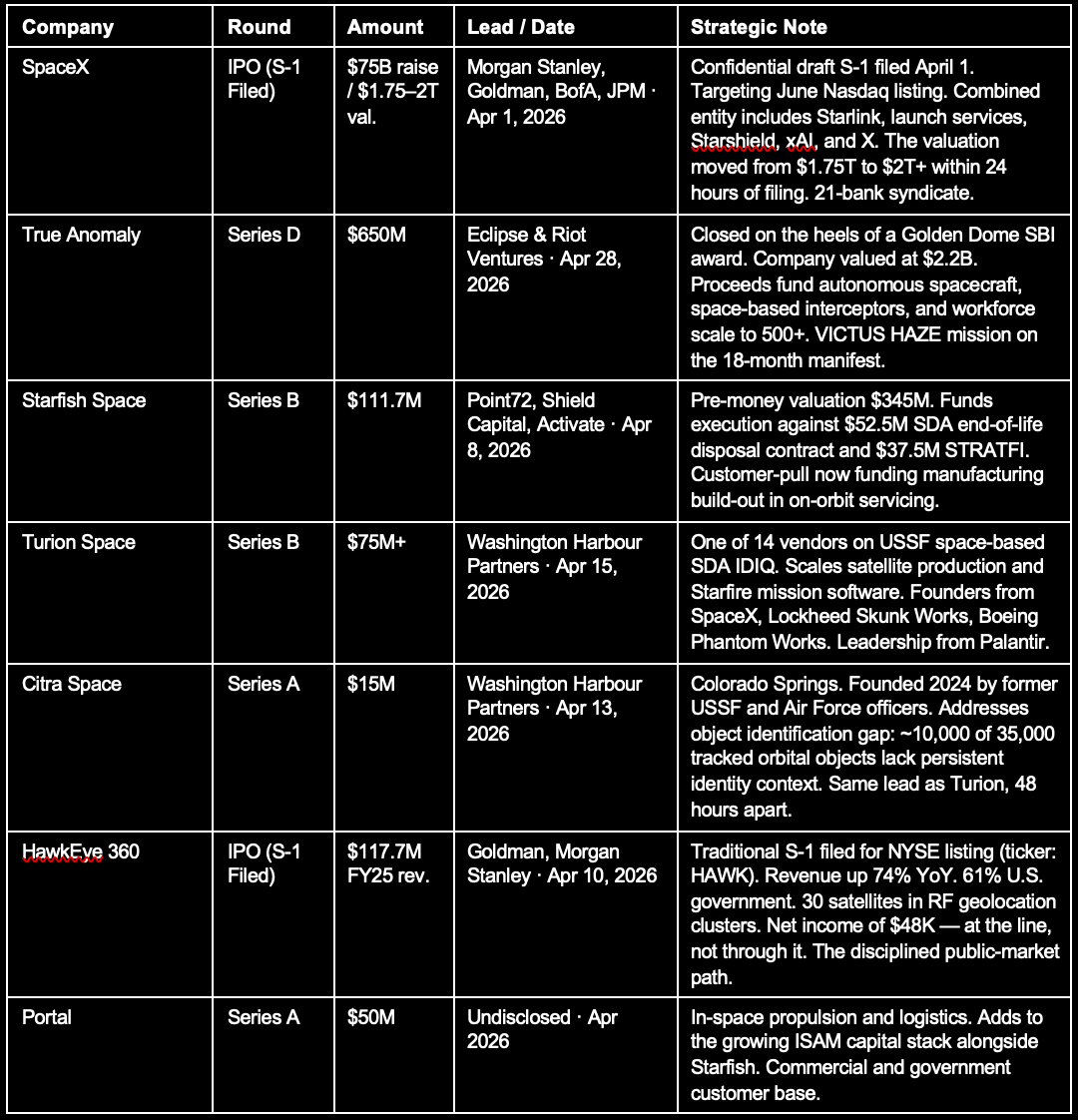
April 2026 Raise Table
The following represent the major financing events of the month. I have organized them by strategic thesis rather than dollar size, because size alone is a misleading filter. A $15M Series A from the right lead into the right mission architecture matters more than a $100M growth round into a business with no government contract moat.
The SpaceX IPO: What the Market Is Not Pricing
SpaceX confidentially filed its S-1 with the SEC on April 1, 2026. Bloomberg, CNBC, and Reuters confirmed the filing independently within hours. The company is targeting a Nasdaq listing in June 2026, a raise of up to $75 billion, and a valuation that opened at $1.75 trillion and was reportedly revised above $2 trillion within 24 hours of the filing becoming known. At $2 trillion against an estimated $18.5 billion in 2025 revenue, SpaceX would trade at approximately 108x trailing revenue at the top of the target range. There is no established public market comparable for a company at this scale trading at that multiple.
The entity filing for public listing is materially different from the SpaceX most investors have tracked through secondary markets. The February 2026 all-stock acquisition of xAI at a combined valuation of approximately $1.25 trillion means the S-1 will describe a company spanning at least five distinct operational segments: Starlink satellite broadband (approximately $10.6B in 2025 revenue, estimated 54% EBITDA margins, per Morningstar), launch services on Falcon 9, Falcon Heavy, and the emerging Starship architecture, Starshield military and national security communications within what is generally understood to be a multi-billion-dollar active government contract portfolio, xAI with the Grok large language model stack and Musk’s stated ambition for “orbital data centers,” and X, the social media platform formerly known as Twitter, which arrived as part of the xAI transaction and carries with it advertising revenue exposure, content moderation liability, and social platform regulatory risk.

The Human Capital Question Nobody Is Asking
The financial press coverage of this IPO has converged on the standard analytical questions: revenue multiple, total addressable market, competitive moat, key-person risk. What I am not seeing addressed in virtually any coverage is the workforce question — and it is the question that most directly concerns the Starship program, which underpins nearly every forward projection in the valuation narrative.
SpaceX has approximately 17,800 employees. Many hold restricted stock units and incentive stock options that vest over three-to-five-year cycles, struck at internal prices that are now worth multiples of their original grant values. The engineers who joined before the valuation trajectory accelerated past $100 billion hold gains that, in many cases, represent career-defining personal wealth. The structural question is whether the mission motivation that has historically compensated for below-market base salaries and demanding working conditions — Glassdoor rates work-life balance at 2.4 out of 5 — remains sufficient once the financial urgency is resolved by liquidity.
Historical precedent from Google (2004) and Facebook (2012) is instructive, if imperfect. Both companies experienced waves of senior technical departures as newly liquid engineers pursued founding activity or simply opted out. Both required years of cultural recalibration and aggressive re-recruiting to restabilize. The counterpoint — and it is a real one — is that SpaceX’s engineering work is physically proximate to hardware. You cannot iterate a Raptor engine from a beach. That institutional knowledge is not portable to a laptop and a Wi-Fi connection. But hardware proximity dampens attrition velocity; it does not eliminate it, and it does not address engagement dilution among equity-saturated technical staff who stay but recalibrate their intensity.
The Starship program concentrates this risk directly. Morningstar notes that SpaceX’s targeted valuation holds together as long as Starship can commercialize on or near its proposed timeline. A delay of 18 to 24 months — not unusual for a program of this complexity and ambition — would pressure the growth narrative precisely when the engineers most responsible for that program are recalibrating their personal financial calculus. The two risk factors compress into the same window.
Governance and the xAI Integration Risk
Reports indicate Musk would retain approximately 79% voting control and a 42% economic stake post-IPO. Public market investors acquire exposure to the asset without meaningful structural recourse if his attention migrates. That is the governance risk Morningstar explicitly identifies. I would add a second dimension: nine of xAI’s eleven original co-founders have reportedly departed since the February merger closed. Musk publicly acknowledged xAI “was not built right the first time around” and confirmed active recruiting to backfill lost research talent. If the xAI integration is experiencing personnel instability before the roadshow begins, the S-1’s workforce risk disclosures may become one of the more carefully read sections of the filing. Watch for what is disclosed — and equally, for what is not.
The IPO roadshow narrative SpaceX selects will determine which class of institutional anchor takes the largest allocation. A telecom story attracts infrastructure funds. A defense story attracts national security capital. An AI story attracts growth investors. Those three cohorts have materially different tolerance for workforce disruption and governance concentration. The valuation will be set by whichever cohort shows up with the most conviction.
DEFENSE CAPITAL
Golden Dome Enters Its First Real Funding Cycle
The Golden Dome missile defense initiative crossed from concept to capital event in April. True Anomaly’s $650M Series D, announced on April 28, arrived directly on the heels of a Golden Dome award for space-based interceptor technology — a product category that did not exist in the company’s portfolio twelve months ago. True Anomaly CEO Evan Rogers framed the raise explicitly: “The doctrine and capabilities required for space superiority are nascent, and industry’s bias towards ‘dual use’ platforms is rendering combat capabilities underserved and unsustainable.” The company will use proceeds to accelerate autonomous spacecraft delivery, scale its space-based interceptor line, and grow the workforce to 500+ employees by year-end.
At the NYSE Space Summit on April 28, a panel including Apex Space CEO Ian Cinnamon, Impulse Space President Eric Romo, and K2 Space CEO Karan Kunjur made the cost argument explicit: the Golden Dome system must achieve a defensible cost-per-kill to survive political scrutiny, and the path to that cost point runs through commercial off-the-shelf hardware. Asked what a Golden Dome satellite bus would have that a commercial satellite bus does not, Cinnamon’s answer was direct: “Hopefully, nothing.”
The investment framing Kunjur offered is the one family offices should internalize: “Almost every major ambitious program over the last 50 years, if that specific program was canceled, you can directly trace five other programs that stemmed from it. As an investor you have to understand how you want to invest in this program — and how you want to invest in the subsequent programs that could stem from it later.” Golden Dome is a forcing function for the broader space superiority architecture regardless of whether the specific program survives its first budget cycle intact. The companies winning Golden Dome awards are building the capability stack that the next program — whatever it is named — will buy.
For investors, the practical signal is this: True Anomaly’s $2.2B post-money valuation on $650M raised is the first legible price discovery event for dedicated space superiority hardware. It will not be the last. The Pentagon’s 12-company, up-to-$3.2B SBI IDIQ from earlier in the program represents the starting gun, not the finish line. IDIQ awards are ceilings, not revenue.
POLICY WATCH
The FY2027 NASA Budget: A Fight Congress Has Already Won
The White House Office of Management and Budget released its FY2027 budget request on April 3, proposing $18.8 billion for NASA — a 23% reduction from the $24.4 billion Congress appropriated in January 2026. The proposal is structurally similar to last year’s FY2026 request, which Congress rejected overwhelmingly, ultimately delivering a budget that exceeded the White House proposal by more than $5.5 billion. The same fight is beginning again.
The proposed cuts follow a by-now-familiar architecture: science programs cut 47%, space technology down nearly a third, aeronautics down 34%, and ISS operations reduced by $1.1 billion. Exploration — Artemis, Moon, and Mars — is the protected line, rising nearly 10% to $8.5 billion. NASA Administrator Jared Isaacman, testifying before the House Science Committee on April 22, defended the framework by arguing NASA must spend smarter rather than spend more, and that the commercialization of launch and standardized spacecraft for smaller missions can free resources for flagship science programs. Committee chairman Brian Babin, a self-described budget hawk, was direct: he does not believe the proposed budget can support what the President has directed NASA to accomplish.
The investor-relevant read on the NASA budget is not the headline number — it is the structural direction of the exploration account. The $8.5 billion exploration request maintains a commitment to a permanent lunar base near the South Pole, accelerated robotic lunar landing cadence, and a nuclear demonstration mission to Mars. The commercial implication is clear: CLPS providers, commercial LEO destination companies, and the lunar logistics supply chain are operating inside a policy environment that, at the exploration level, is directionally bullish regardless of the science funding battle. Congress will restore science. Exploration stays funded either way.
Watch the ISS transition, not the headline cut. NASA’s proposal to attach a new government-owned module to ISS — allowing CLD companies to dock their modules and reduce build costs — is being actively opposed by the CLD providers themselves, who insist there is a commercial market if NASA maintains the original transition plan. That disagreement is the investable tension in the LEO economy for the next 18 months. SHOCKER…my guess, the transition will be slow.
POSITION
Where This Leaves the Investor
Three structural shifts arrived simultaneously in April, and they compound each other. The SpaceX IPO creates a public market reference for space infrastructure that will pressure private valuations, clarify exit paths for venture-backed companies, and attract a new class of institutional capital to the sector — capital that currently has no liquid vehicle for space exposure beyond the legacy primes. That changes this summer regardless of where SpaceX prices.
Golden Dome creates a defense budget line that does not exist in prior-year appropriations baselines, which means the political support for it is being built in real time rather than inherited. True Anomaly’s $650M raise and the Pentagon’s 12-company SBI IDIQ are the first price signals for a capability market that will absorb several billion dollars of annual procurement spend if the program matures. Companies that are winning awards now are establishing the contractor relationships and clearance profiles that will define competitive position for the next decade of space superiority acquisitions.
The Washington Harbour Partners signal — two leads in 48 hours, both in the USSF-aligned space domain awareness thesis, both with company leadership carrying operational military experience — is worth carrying as a fund-level indicator. When a single fund takes the lead position across multiple companies operating in the same mission set, the cap tables of those companies share a concentrated view on how that mission set should be built. That is useful intelligence for any investor underwriting the same thesis independently. It is also the kind of concentration risk that warrants monitoring as the portfolio matures and government budget cycles introduce their own timing pressures.
The NASA budget fight is noise for investors with a 5-to-10-year horizon. Congress will not let the science programs collapse, and it will not let the exploration account erode while China is building lunar presence. What matters is the structural commercialization direction: the government is increasingly willing to buy capability rather than build it, and the FY2027 budget request — even in its cut form — is consistent with that direction. The commercial space economy’s best customer is not going anywhere…but will continue down the same slow course.
The month’s summary in one sentence: The SpaceX IPO opened the public-market door for space infrastructure, Golden Dome funded the first dedicated space superiority hardware cohort, and the private capital market demonstrated it does not need the public market to validate what it already knows — that the space economy is the decade’s most durable defense, telecommunications, and infrastructure investment thesis.